Abstract
This article gives an
impression how existing RDFS
based Semantic Web knowledge web services can already now be
integrated in the creation process of semantic nets in MS Visio with SemTalk. We are presenting two examples: looking up object names in WordNet and using Ontobroker as an inference engine on ECCMA [11]
ontologies. This article shows how
different 2-dimensional visualization techniques such as DAMLVisio [5] or simple Visio shapes can be applied to semantic web models in order to address a broad range of
users with very different expectations on the notation.
Keywords: RDFS, Web Services,
Visio, Ontobroker
1. Introduction
SemTalk [1], using a Microsoft Visio front-end, offers an easy to use editor for semantic web ontologies and processes. Using an open,
graphically configurable meta model, Visio can be easily adapted to different model worlds such
as CASE Tools and organizational models. These models, with the help of
Microsoft Office XP SmartTags, allow users to easily use semantic webs during their daily work with other MS Office products such as Winword, Excel or Outlook.
The whole idea of the semantic web is to share common – more or less –
formalized knowledge via the Internet [2]. While the main idea was to establish a common knowledge
platform for machines, we are focussing on people
exchanging their ideas in a (graphical) knowledge network. Key issue for
sharing knowledge is the use of a common terminology, e.g. in form of
ontologies [3]. Though there exists already common practices how to develop and
use ontologies [4], ontologies are due to their complex nature far from being a
commodity and require substantial tool support during development.
Most of the existing online and offline glossaries can
be viewed by browsers that visualize exactly one node in an network. Some tools generate hyperbolic trees
or similar visualizations on demand. Our experience about communicating
knowledge is, that complex problems can better be understood by manually
created diagrams describing a specific scene or scenario.
People prefer using a mixture of drawing
tools combined with modelling tools which gives them
a great flexibility to use the advantages of both. This article shows how
different 2-dimensional visualization techniques as DAMLVisio [5] or UML [6] can be applied to semantic web models using Visio for multiple audiences. Our goal is to integrate
existing RDF(S) [7,8] based semantic web knowledge services tightly into the
creation process of semantic networks and business processes. We are covering
too examples: looking up object
names in WordNet [9] and using Ontobroker [10] as an inference engine to process ECCMA
ontologies.
2.
Architecture
SemTalk does work on an RDF(S)-like XML data structure. Diagramming information and object oriented features like methods and states have been added to RDF(S). It also has an optimized structure for basic
inferences as inheritance and graph traversals. There is an object engine providing a COM API in order to be able to use
the engine within MS
Office products.
For the graphical presentation of models we have used MS Visio for two reasons: (i) the
tool is widely used in industry, therefore people are used to it and (ii) it
is easily extensible through an API.
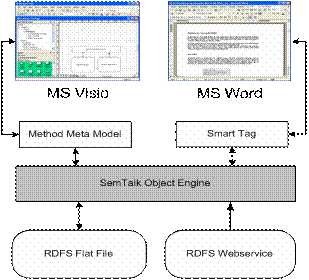
Figure 1: Architecture Overview
of SemTalk
The SemTalk object
engine is used to define semantics - in other words a Meta Model - for existing
Visio shapes. You can graphically define which shapes are allowed to be connected with each other. SemTalk supplies the infrastructure to define
complete modeling methods inside Visio. Those methods are e.g. for DAML, for Enterprise Resource Planing (ERP)
product modeling and for Business Process Modelling
(BPM) methods. SemTalk has a couple of interfaces to CASE tools like Rational
Rose and to BPM
tools. There is a
simple report generator that creates HTML tables by using XSL for formatting.
3. Notation for Semantic Webs
In respect to the very broad audience we want people
to be able to read our models without learning a notation. We have best
experiences using the very simple bubble notation, shown in some of the
pictures below. It is important to label most of the links and not to use
graphical encodings which are known from graphical languages as Entity
Relationship diagrams or UML.
For readers with a technical background more complex
notation with various shape types can be used. Examples are the DAML
Notation and e.g. a user interface for a product configuration engine.
One of the great advantages of using Visio is that is contains a large collection of predefined
and extendable shapes. The shapes correspond quite natural to classes. Using pictures improves the acceptance of the
models which is an important success factor in Knowledge Management.
4.
WordNet
WordNet®, which was developed by the Cognitive Science
Laboratory at Princeton University under the direction of Professor George A. Miller, is a huge online lexical reference system whose
design is inspired by current psycholinguistic theories of human lexical memory.
English nouns, verbs, adjectives and adverbs are organized into synonym sets, each representing one underlying
lexical concept. Different relations link the synonym sets. SemTalk uses WordNet via Dan Brickley’s RDF(S) web service for WordNet 1.6 [12].
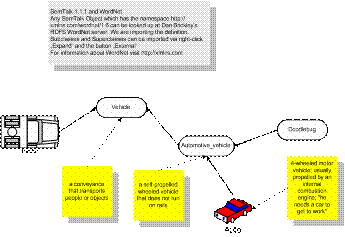
Figure 2: A small vehicle model
build from WordNet
The models are being build with external model
repositories incrementally. Once you have used a class name in a model you can look for related objects in external repositories and integrate them into
your model (Figure 3). The idea of using an external glossary basically ensures
that people are talking about the same thing with a well defined Uniform Resource Name (URN) to identify objects and related hyperlinks to access their definitions.
The other benefit users have from such ontologies is that they are getting
hints for related objects or subclasses to use in the model.
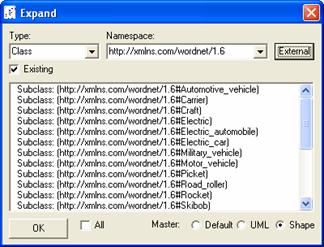
Figure 3: Subclasses of vehicle
offered by WordNet
The objects remember their origin and can be refreshed (or
replicated) from their external data source once the source has changed.In a very similar way you can link one class to a another class living in an external model which was created using SemTalk and which is published on a web server.
This technology results in a web of hyperlinked models based on RDF(S) as a common standard.
5.
Ontobroker
Finding knowledge on the semantic web can be done more intelligent than just
looking up words in a dictionary even if this is based on RDF(S). Additional to web services such as WordNet and
the SemTalk internal indexing inference engines like Ontobroker can
provide a new dimension of reasoning capabilities.
Ontobroker exploits knowledge models and data from different
sources to answer queries. For that purpose it evaluates axioms contained in
the knowledge models to derive new knowledge or to check the consistency of the
available knowledge. It runs as a middleware system and thus may be used by a
variety of applications of as an information delivering base. Ontobroker is already used by the W3C as a reference
implementation (SiLRI [13]) as an inferencing
tool for semantics for the Web.
Ontobroker can be accessed as a web service similar to WordNet. SemTalk stores models as knowledge bases somewhere
on a webspace reachable for Ontobroker. A query in Ontobrokers query language F-Logic [14] and a list of
possibly relevant knowledge bases is being send to an Ontobroker server. The server returns a list of XML
encoded solutions to the query. Each
variable binding in a solution can be a reference to an object in a knowledge base. The user can insert objects into SemTalk directly from the URNs
provided in the result set.
Figure 4 is showing the query interface in SemTalk. A user selects one or more ontologies and
a query. The Result set consists of all possible Solutions for the F-Logic
query “FORALL
X,Y<-X::Y.” which means X is a (direct or
indirect) subclass of Y.
In the example we are using a subset (Farming &
Fishing & Forestry & Wildlife &..) from a large ontology named
Universal Standard Products and Services Classification (UNSPSC) developed by ECCMA.
The Electronic Commerce Code Management Association (ECCMA) is a not-for-profit, unbiased,
membership organization that oversees the management and development of the
UNSPSC Code. The UNSPSC is a new classification first developed in the summer
of 1998. Both the Dun & Bradstreet Standard Product and Services Classification (SPSC) and the United Nations Development
Program (UNDP) United Nations Common Coding System (UNCCS) were used in its
development. The UNSPSC currently covers 56 industry segments from electronics
to chemical, to medical, to educational services, to automotive to
fabrications, etc.
A good overview of this and similar content standards
can be found at [17].
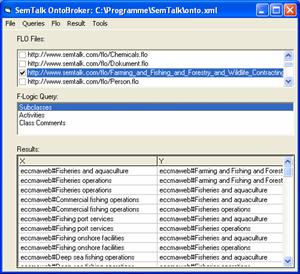
Figure 4: Administration of Ontobroker
The mission of SemTalk is to empower end users to publish models to the semantic web and to exploit the knowledge from their
desktop applications. Since we do not expect end user to learn and use an object oriented
logical language like F-Logic, we have build a query-by-example-style
graphical interface show in Figure 5.
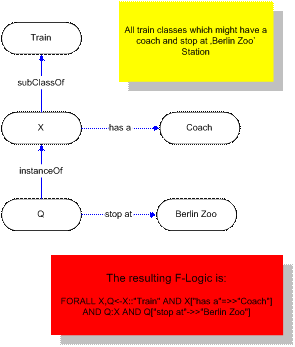
Figure 5: A graphical F-Logic
Query
Queries are defined the same way users are already
familiar with from reading the models. Existing models can be used as patterns.
Some parts of the model are marked as variables (single uppercase character).
The graphical query is then translated to F-Logic and send to Ontobroker.
6. DAML
DAML is the Darpa Agent Markup Language [15].
The goal of the DAML effort is to develop a language and tools to
facilitate the concept of the semantic web. DAML is basically a much richer layer on top of RDF(S). For SemTalk we are using the VisioDAML shapes developed by John Flynn [5].
What SemTalk currently does for
DAML is:
- driven by the meta-model it will check if you can
use a connector between any to objects e.g. you can
not use "SubClassOf" between
to instances.
- keep consistency between multiple visualizations
of the same object.
- navigation etc.
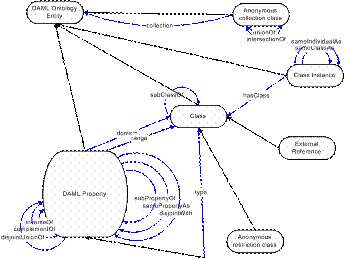
Figure 6: Subset of the DAML
meta-model in SemTalk
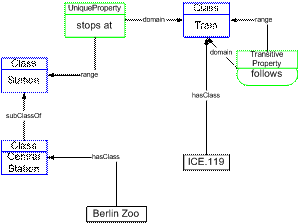
Figure 7: DAML Notation in SemTalk
The (RDF(S) compatible) classes which you will find in SemTalk are just used for the DAML meta model
(Figure 6). The SemTalk object engine controls which pairs of shapes may be connected. E.g. a “subClassOf” connection is not allowed between a class and a property.
Figure 7 is a DAML drawing build with SemTalk. A DAML class is represented as an
instance of the SemTalk class "DAML#Class", DAML instances are instances of the
SemTalk class "DAML#Instance".
"DAML#HasClass" is just a link between two SemTalk instances. This implies that the basic
inferences like inheritance of attributes are not available for DAML in the dialogs.
Compared to this the integration of RDF(S) is much deeper. If we read an RDF(S) file we are creating SemTalk classes which can be used as:
-
classes for Visio masters
-
business objects in business
processes
-
...
SemTalk classes
implement a subset of RDF(S) (e.g. no SubProperty of, binary properties only).
The current DAML Visio shape set does not cover
the DAML extension DAML+OIL [17]. As
soon as a proposal for a depiction of DAML+OIL is available this can be implemented
in SemTalk by extension of the graphical Meta Model and by
adding the new Visio shapes.
7. Using
the Semantic Web from MS Office XP
If you read this
text from an Internet Explorer 6.0 or Word XP you will mention a SmartTag on the word SmartTag in this sentence as shown in Figure 8.
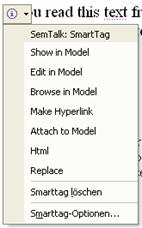
Figure 8: A SmartTag action menu
SmartTags are recognized while you a typing. The SemTalk SmartTag Recognizer finds any class in models of users choice. The “HTML” option will open an HTML representation of the model.
“Make Hyperlink” converts the SmartTag into a
static hyperlink for those users not having IE. Static Hyperlinks are early
bound (in the context of the author) while SmartTags are using late
binding (in the context of the reader). Late Binding is more
interesting since it may translate terms from one context to another on the fly.
If users have SemTalk installed on their machine they may also edit the
underlying Visio model in order to add new information to
the model or change the text
based on linked objects from the model.
SmartTag technology is recognized by most of the users as one
of the key enablers for knowledge management because it is proactive. It points the user to the
semantic model which describes in an easy understandable way what the text / email / sheets is talking about. This technology
helps e.g. (i) technical writers to be sure to use
the right term in their context Or
(ii) shows a business process that
describes how to proceed.
A concrete usage scenario for this approach is to
ensure the consistency of technical documentation in the IT department of a
bank [16].
8.
Summary
Using SemTalk models are able to give context to keywords.
They also create a starting point to understand and communicate process
information. As the availability of semantic web knowledge source is increasing, the need for reliable
and scalable inference engines such as Ontobroker becomes obvious.
The Visio editor enables a wide range of users to use and
understand models. By the integration of the technology into the daily work
processes, the acceptance, and thus the usefulness of the models rises.
9. References
|
[1]
|
Fillies,C.; Weichhardt, F.; SemTalk: A RDFS Editor for Visio 2000
Position Paper, ICCS 2001 9th International Conference on
Conceptual Structures / Semantic Web Working Symposium (SWWS)
|
|
[2]
|
Tim Berners-Lee, Jim Hendler, and Ora Lassila published an article
about the Semantic Web in Scientifc American. "A new form of Web
content that is meaningful to computers will unleash a revolution of new
possibilities". See http://www.scientificamerican.com/2001/0501issue/0501berners-lee.html
|
|
[3]
|
Gruber, T.
(1995). Towards principles for the design of ontologies used for knowledge
sharing. International Journal of Human-Computer Studies, (43):907–928.
|
|
[4]
|
S. Staab, H.-P. Schnurr,
R. Studer, and Y. Sure. Knowledge
processes and ontologies. IEEE Intelligent Systems, Special Issue on Knowledge
Management, 16(1), January/Febrary
2001.
|
|
[5]
|
John Flynn. DAMLVisio Shapes, cf. http://www.daml.org/visiodaml/
|
|
[6]
|
Booch, G., Rumbaugh, J. and
Jacobson, I. (1999) The unified modeling
language user guide, Addison-Wesley,
Reading Mass.
|
|
[7]
|
W3C. RDF Schema Specification. http://www.w3.org/TR/PR-rdf-schema/, 1999.
|
|
[8]
|
O. Lassila and R. Swick. Resource description framework (RDF). model and syntax specification. Technical report, W3C, 1999. W3C
Recommendation. http://www.w3.org/TR/REC-rdf-syntax.
|
|
[9]
|
WordNet,
cf. http://www.cogsci.princeton.edu/~wn/
|
|
[10]
|
S. Decker, M. Erdmann, D. Fensel,
and R. Studer. Ontobroker: Ontology Based access to Distributed and Semi-Structured
Information. In R. Meersman et al., editors, Database
Semantics: Semantic Issues in Multimedia Systems, pages 351–369. Kluwer Academic Publisher, 1999.
|
|
[11]
|
cf. http://eccma.org/unspsc/
|
|
[12]
|
Dan Brickley. RDF(S) web service for
WordNet 1.6, cf. http://xmlns.com/2001/08/wordnet/
|
|
[13]
|
S. Decker, D. Brickley, J. Saarela, J. Angele. A Query Service for RDF. Query Languages
98, W3C Workshop.
|
|
[14]
|
M. Kifer, G. Lausen, and J. Wu. Logical foundations of object-oriented and frame-based languages. Journal of the ACM, 42,
741–843, (1995).
|
|
[15]
|
Darpa Agent Markup Language
(DAML), cf. http://www.daml.org
|
|
[16]
|
Fillies, C., Wood-Albrecht, G., Weichhardt,
F., A Pragmatic Application of the Semantic
Web Using SemTalk. WWW2002, May 7-11, 2002, Honolulu, Hawaii, USA
ACM 1-5811-449-5/02/0005
|
|
[17]
|
DAML+OIL ontology markup
language, cf.
http://www.daml.org/2001/03/reference.html March 2001
|
|
[18]
|
Dörr, M., Guarino, N.,
Fernández López, M., Schulten,
E.,
Stefanova, M., Tate, A., State of the
Art in Content Standards. OntoWeb
Deliverable 3.1.
www.ontoweb.org/download/deliverables/D3.1.pdf
November 2001
|